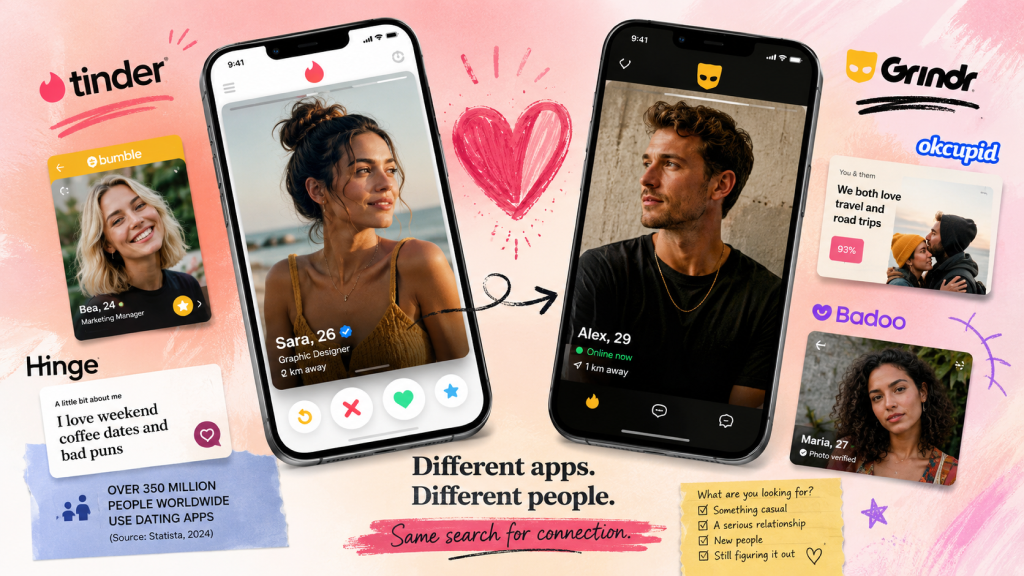
On Hinge, Tinder, and Bumble, the photos that win in 2026 are the ones that don't look edited. A photographer's case for restraint, and the small edits that actually move the needle.
There is a particular look you can spot on a dating app from across the room. Skin smoothed into porcelain. Eyes brightened a stop too far. A jawline that does not appear in any other photo on the profile. It is the look of a face that has been processed — by an aggressive filter, a one-tap AI "enhance," or fifteen minutes of nervous slider-dragging in an app designed for selfies, not portraits.
That look is losing.
Hinge's own engagement data, surfaced by analytics tools like Trushot and SwipeStats, shows that the photos pulling the highest like-rates in 2026 are the ones that read as real moments — candid frames outperform posed studio shots, forward-facing headshots clear ambiguity, and the people who get more matches tend to share one thing in common: their photos look like them. Not a flattering invention of them. Them.
For an industry built on appearances, that is a quietly radical shift. And it has changed what "editing a dating photo" actually means.
The new standard: recognizable, not retouched
For most of the swipe-app era, the dating-photo arms race ran in one direction — more filter, more smoothing, more saturation, more flare. Then the verification loops caught up. Tinder, Bumble, and Hinge all built selfie-matching systems explicitly designed to compare the live face in front of the camera to the face in the profile. The message from the platforms is the same as the message from anyone who has ever showed up to a coffee date and felt their stomach drop: photos that diverge too far from reality do not pay off. They just delay the disappointment.
Working dating-portrait photographers describe the same shift. "Every photo should make it easy to say, 'yes, that still looks like me,'" writes the team at San Francisco's Pacifica Studio, in a guide that has become something of a reference document among Bay Area daters. The frame they offer is useful: a good dating photo should pass the recognition test in any lighting, with any haircut you might actually have on any given Tuesday.
Unlike the common myth of any face should be as hot as the OnlySpins Casino shows their players to attract their attention, it works a bit different in real life dating.
*OnlySpins is modern online casino made around the dating apps culture and vibe
Hinge's interface puts even more pressure on this. The first image is shown nearly full-bleed; a face that is technically yours but visually a stranger is a profile that will not lead to a second meeting.
Refine, don't transform
Koby Brown, a London-based commercial photographer who shoots dating portraits alongside editorial work, has written what is probably the cleanest articulation of the modern editing philosophy:
"The word to keep in mind is refining rather than editing or retouching."
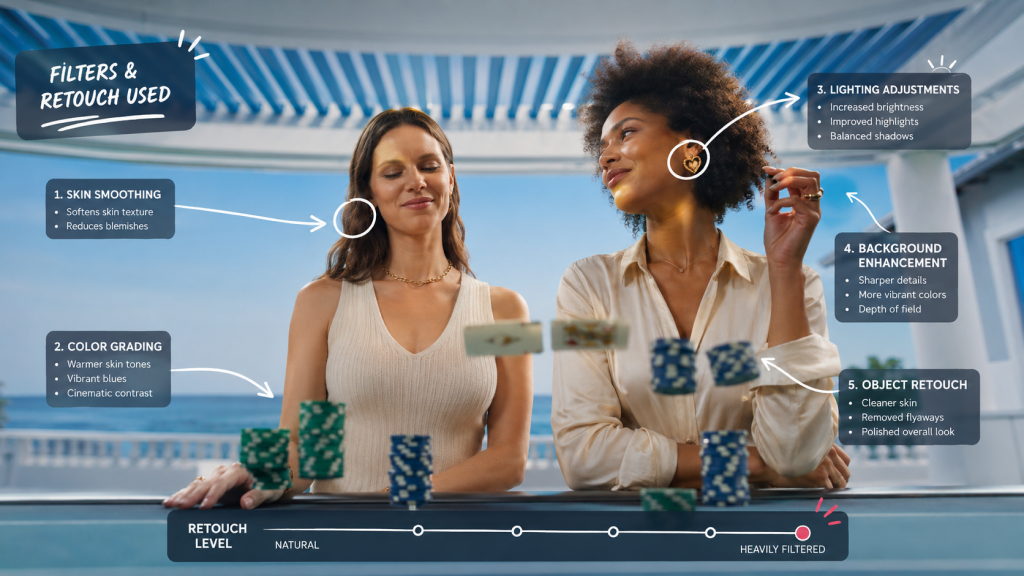
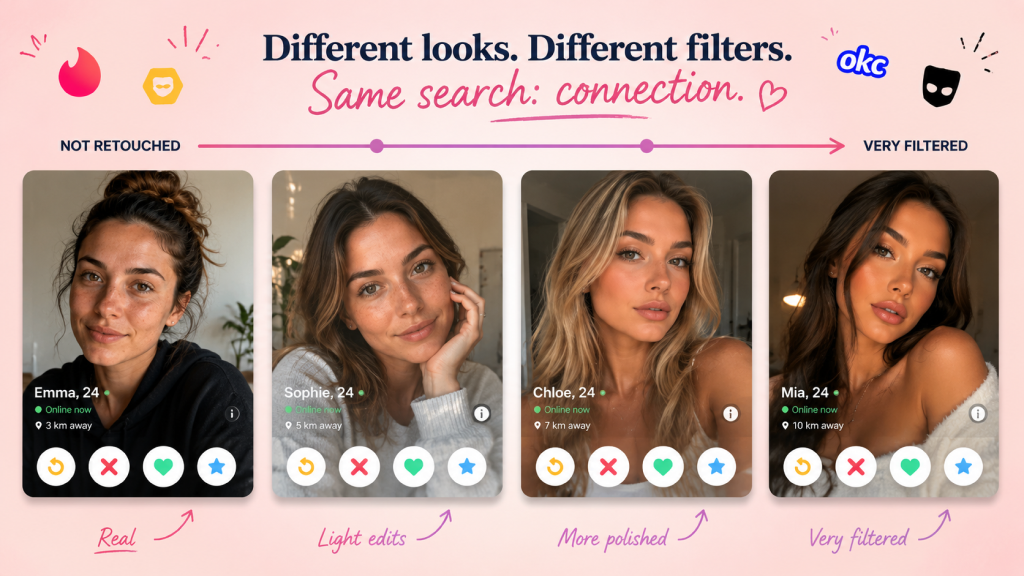
It is a small distinction with large consequences. Refining means working with what the camera captured — correcting white balance that drifted warm under tungsten light, straightening a horizon, nudging shadows to recover detail in a backlit face, easing a sunburn down half a stop. Editing, in the casual sense the word has taken on, often means inventing — smoothing skin into plastic, narrowing a nose, brightening teeth past the point of believability, lifting a sky from a photograph it was never in.
The first protects the photograph. The second replaces it.
The tell, for anyone who has spent time looking at portraits, is almost always skin. The moment skin texture goes — the moment pores and faint shadows under the eyes disappear into a uniform matte surface — the photograph stops being a portrait and starts being an illustration. People do not consciously think "that skin has been smoothed." They just feel that something is off, and they swipe.
This is where opinionated, photographer-built editing tools earn their keep. The styles in Priime are not selfie filters; they are looks built by working photographers around color, contrast, and tone. A portrait style nudges warmth, gently lifts midtones, and lets skin keep its texture, because the people who built it know what a face is supposed to look like in a finished photograph.
What the data is really saying
The recent platform-level numbers — candid shots earning roughly 15% more likes than posed ones, forward-facing headshots more than doubling engagement, athletic and outdoor photos outperforming static studio looks — all point in the same direction. Dating in 2026 rewards photographs that feel like life, edited the way a photographer would edit a magazine portrait: with care, with intention, and with the kind of restraint that lets the subject remain the subject.
A dating profile is one of the strangest portrait commissions in modern life. The brief is impossible: be flattering but honest, casual but composed, current but timeless. The temptation to reach for a one-tap transformation is real.
The better instinct is the older one. Treat the photo like a photograph. Correct the light. Honor the color. Leave the skin alone. Let the person in the frame look like the person who will, one Saturday morning, walk into a café and sit down across from someone who is already smiling because they recognize them.
That is the edit worth making.
The four edits that actually move a dating photo
Most dating profile photos do not need much. They need the right things.
Exposure and white balance. More dating photos are lost to mixed indoor lighting than to anything else — the warm-orange cast of restaurant tungsten, the green flicker of office overheads, the harsh blue of midday window light on one side of a face. Correcting these is the single most flattering thing you can do to a portrait, and it does not change the person at all.
Contrast and color, restrained. A small contrast lift gives a photo presence in a thumbnail grid. A subtle warm shift on skin tones reads as health rather than makeup. Photographer Allison Busch's standing advice — "keep skin tones natural and textures realistic" — is the line not to cross. The instant a face shifts from sun-kissed to sun-cooked, you have lost the recognition test.
Crop and composition. The Hinge thumbnail is small. A wide group shot from your friend's wedding is not your first photo, no matter how good you look in it. Cropping a strong frame tighter — face clearly in the upper third, eyes near the center line — does more for your match rate than any filter.
Restraint with skin. If you take one thing from any working portrait photographer's editing process, take this: leave the texture. A few seconds of healing on a single distracting blemish is fine. Sliding a "smooth skin" control toward maximum is the modern equivalent of putting a Glamour Shots vignette on your headshot in 1994. People can tell.