From Tarot Cards to Algorithms — Three Thousand Years of Trying to Predict the Future
Around 1700 BCE, in a temple in southern Mesopotamia, a priest in a linen robe is examining the freshly extracted liver of a sacrificial sheep. The lobes, the position of the gallbladder, the marks on the surface of the organ are being read against a corpus of clay tablets that record what each variation has historically signified. A king has paid for this consultation because he is contemplating a military campaign and wishes to know its likely outcome. Around 1700 CE — three and a half thousand years later — in a Parisian salon, a woman is laying out a deck of seventy-eight illustrated cards in a pattern of crosses and stars to advise a client about whether to accept a marriage proposal. Around 2024 CE, in a server farm somewhere in northern Virginia, a deep learning model is processing the financial transactions of a person who has just applied for a mortgage in order to produce, in milliseconds, a number representing the probability that they will default within seven years.
These three scenes are separated by three thousand seven hundred years and by transformations of technology, religion, science, and economy so complete that almost nothing about them is the same. They are, on inspection, the same activity. A human being who cannot tolerate complete uncertainty about a future they care about is consulting an apparatus that promises to extract usable information from observable signs. The apparatus has changed. The activity has not. The history of how it changed, and what its continuity reveals, is one of the more useful narratives the long view of human culture has to offer.
The ancient apparatus
The diversity of pre-modern divinatory systems is striking, and the consistency of their purpose is more striking still. In Mesopotamia, the practice of haruspicy — reading the livers of sacrificed animals — was organised into a literate profession with manuals and clay liver-models for training, surviving examples of which can be found today in major archaeological collections. In China, the I Ching developed from yarrow-stalk divination in the early Zhou dynasty into a structured system of sixty-four hexagrams whose interpretation became a serious branch of philosophical study. At Delphi, the Pythia consulted on policy decisions of Greek city-states for nearly a thousand years; rulers travelled across the eastern Mediterranean to put questions to her. In Rome, an entire civil priesthood — the augurs — interpreted bird flight, lightning, and entrails before significant public acts. In West Africa, the Yoruba tradition of Ifá produced a divinatory corpus so vast that its priests were required to memorise hundreds of verses associated with the possible outcomes of a single throw of palm nuts. The Norse cast runes; the Romani read palms; the Tibetans interpreted dough figures.
The diversity of methods conceals a common architecture. Each system takes some natural variation — entrails, sticks, cards, stars — and reads it against an interpretive corpus that maps the variation onto statements about the future. The corpus is maintained by a specialised priesthood. The client pays for the consultation. The outcome is delivered with sufficient ritual to make it credible. And the system works, in the sense that matters most to its users — it makes the unbearable absence of information about the future bearable.
The astrological systematisation
The most ambitious pre-modern attempt to render divination rigorous was astrology, which beginning in Babylonia and reaching maturity in the Hellenistic world tied predictions of human fate to observable celestial mechanics. Ptolemy's Tetrabiblos, composed in the second century CE, was the definitive ancient treatise, integrating astronomy and astrology into a single technical discipline that would be taught in European universities for the next fourteen hundred years. Astrology mattered because it was the first predictive system to insist that its rules were derived from regularities of nature rather than from the will of gods. Cardano cast horoscopes; Kepler made astrological predictions for clients who funded his astronomical work; medieval Islamic mathematicians produced some of the most sophisticated astrological tables in history. The discipline was, by the standards of its time, scientific. Its eventual decline reflected not the discovery that it did not work but the rise of a different framework that worked better.
Tarot as invented tradition
A small but instructive case study in the history of prediction is the European tarot. The decks of seventy-eight cards now associated with divinatory practice originated in fifteenth-century Italy as luxury gaming objects — the Visconti-Sforza decks, painted around 1450 for the ducal court of Milan, are among the earliest surviving examples. For nearly three centuries the cards were used to play tarocchi, a trick-taking game similar in structure to bridge. The divinatory use of tarot, which by the twentieth century would feel ancient and mysterious, was invented in late-eighteenth-century France. Antoine Court de Gébelin proposed in 1781 that the cards encoded ancient Egyptian wisdom; Etteilla published the first divinatory tarot deck in 1791; the occultist Éliphas Lévi systematised the associations in the mid-nineteenth century; the Rider-Waite-Smith deck of 1909 codified the modern visual language. The whole edifice of "tarot reading" is, in historical terms, younger than the United States.
The tarot case is worth dwelling on because it demonstrates the human propensity to construct divinatory systems where none existed. Given a striking set of visual symbols, a literate culture, and a market of clients, the predictive apparatus will appear. The cards did not become divinatory because they were divinatory. They became divinatory because a sufficient number of people decided that they should be.
The broader lesson extends well beyond tarot itself. Human beings repeatedly take systems that were originally created for play, entertainment, or social interaction and reinterpret them as mechanisms for meaning-making. Once a symbolic structure acquires enough cultural attention, people begin to project narratives, expectations, and hidden patterns onto it. This tendency helps explain why activities involving chance have so often occupied a space somewhere between recreation and ritual throughout history.
Modern entertainment platforms continue to operate within environments shaped by the same psychological instincts. A brand such as DicePalace, although belonging to a completely different technological and cultural context, exists within a tradition in which uncertainty remains inherently attractive to the human imagination. The enduring appeal of games of chance is not simply that outcomes are unknown, but that people instinctively search for significance within uncertainty itself. The history of tarot demonstrates how readily that search can transform ordinary objects into systems of interpretation, and how deeply rooted the desire to discover meaning in randomness remains across centuries.
The probability revolution
The watershed in this history is the year 1654, when the French mathematicians Blaise Pascal and Pierre de Fermat conducted a famous correspondence on the problem of points — how to divide stakes if a game of chance is interrupted before completion. Their letters, brief and informal, established the mathematical foundations of probability theory. Within a generation, Christiaan Huygens had published the first textbook on the subject; Jacob Bernoulli had proved the law of large numbers; Abraham de Moivre had derived what would later be called the normal distribution; Thomas Bayes had introduced conditional probability and inference from evidence. By the early nineteenth century, Pierre-Simon Laplace had built an entire treatise of analytical probability that included, as a famous thought experiment, the demon that could predict the entire future of the universe given complete knowledge of its present state.
The conceptual change introduced by probability was profound and irreversible. Older predictive systems had claimed access to specific information about the future — this campaign will succeed, this marriage will be auspicious, this child will live to be eighty. The probabilistic frame replaced that ambition with a quantified description of uncertainty: this outcome has a 73 per cent likelihood, that one has 19 per cent, the remainder is distributed across other possibilities. The future was no longer being read; it was being modelled. The model could be wrong, and was often wrong, but it admitted its own uncertainty in a way no haruspex had ever done. This was a different epistemological structure, and the cultures that adopted it would in the following two centuries pull substantially ahead of those that did not.
Statistics and the industrialisation of prediction
Through the nineteenth century, probability matured into the more empirical discipline of statistics. Adolphe Quetelet's social physics in the 1830s and 1840s introduced the idea of the average citizen and made population-level prediction possible. Francis Galton — whose work on eugenics was deeply problematic but whose statistical contributions were not — developed regression and correlation. Karl Pearson and Ronald Fisher built the modern methodology of statistical inference in the late nineteenth and early twentieth centuries. The actuarial profession, born to support life insurance, became a serious applied science. Weather forecasting emerged as a public service when Robert FitzRoy, head of the British Meteorological Office, coined the term "forecast" in the 1860s and began issuing daily predictions to the Royal Navy.
By the mid-twentieth century, prediction had become an industrialised activity. Operations research arose in the Second World War to optimise military logistics. Norbert Wiener's Cybernetics (1948) articulated a general theory of feedback and control. Claude Shannon's information theory, published the same year, gave mathematical form to the concept of uncertainty itself. ENIAC computed the first numerical weather forecast in 1950. The Monte Carlo methods developed at Los Alamos turned random sampling into a serious computational tool. Markov chains, time-series analysis, hidden Markov models, and Bayesian networks accumulated through the second half of the century into a substantial technical apparatus.
The algorithmic present
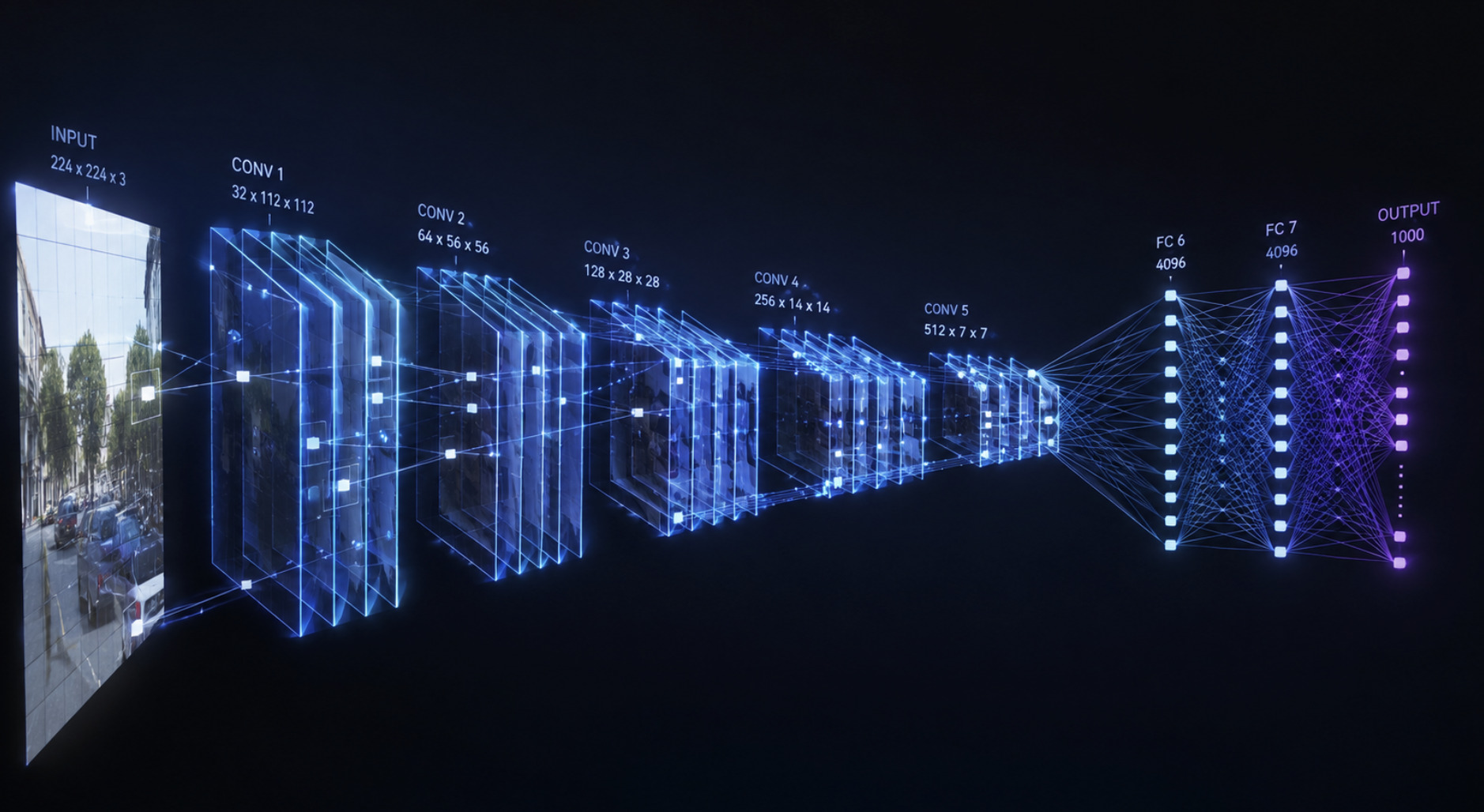
What we now call machine learning is a continuation of this trajectory by other means. The conceptual ancestry of modern algorithms runs back through statistical learning theory of the 1990s, pattern recognition of the 1970s and 1980s, perceptron research of the 1950s and 1960s, and ultimately to the same probabilistic and statistical foundations laid down by Pascal, Bayes, and Laplace. The genuinely new development of the past fifteen years — deep learning, transformers, large language models — represents a substantial increase in the scale and capability of the predictive apparatus, but not a fundamentally new kind of predictive ambition. A language model is, at its computational core, a prediction system that estimates the probability of the next token given the preceding ones. A recommendation engine predicts which content the user will engage with. A credit-scoring algorithm predicts default probability. A modern logistics system predicts demand. The entire infrastructure of the contemporary digital economy runs on machine prediction the way the Roman state ran on augury — pervasively, professionally, and with a degree of social authority that allows it to function without most of its users understanding how it works.
The structural continuity
What the long view of this history makes visible is a continuity that the participants in any given era rarely notice. The visible apparatus has changed completely — the haruspex's liver, the astrologer's chart, the actuary's table, the data scientist's notebook share almost no surface features. The underlying activity is recognisably consistent: a specialised practitioner consults a system that maps observable signs to statements about the future, on behalf of a client who pays for the consultation, with sufficient procedural authority to be credible. The priesthood changes its robes. The function does not.
Two qualifications deserve to be acknowledged. The first is that the systems really have got better. A modern statistical forecast of next week's weather is genuinely more accurate than a Babylonian omen. A well-calibrated credit model genuinely predicts default better than the moneylender's intuition. The probabilistic revolution, by quantifying uncertainty rather than denying it, gave human prediction an honesty that older systems did not have. To collapse the modern apparatus into mere astrology in a lab coat would be to miss the genuine epistemic advance. The second qualification, however, is that the scale of contemporary predictive infrastructure introduces problems the ancients did not have. Algorithmic predictions now shape the futures they are predicting; feedback loops form between models and behaviour; the predictions become self-fulfilling in ways that omens never could.
What remains constant beneath the technological transformation is the underlying need. Human beings do not appear able to tolerate complete uncertainty about the future, and they construct, in every epoch and every culture, apparatuses to mitigate it. The apparatuses become more sophisticated, more accurate, more honest about their own limitations. The question they are asked to answer, however, has not changed since the priest in the Mesopotamian temple. What will happen? How can I be ready? Three thousand seven hundred years of intellectual effort have made the answers better. They have not made the asking less necessary, and on the available evidence they are unlikely ever to do so.