A photograph that looks more real than the moment
What follows is an imagined scene, offered to frame the argument. It describes no real photographer or image.
It is late afternoon in a narrow street, and the light is against her. The sun has dropped behind a row of buildings, so the pavement sits in cool shade while the upper floors still burn orange. An elderly man is crossing the road with a loaf of bread under his arm. She raises the camera and gets one frame.
At home, the file is disappointing in the ordinary ways. The shadows are muddy. A delivery van's wing mirror cuts into the left edge. A lamppost rises directly behind the man's head, and a passing cyclist has blurred across his shoulder, hiding part of his face.
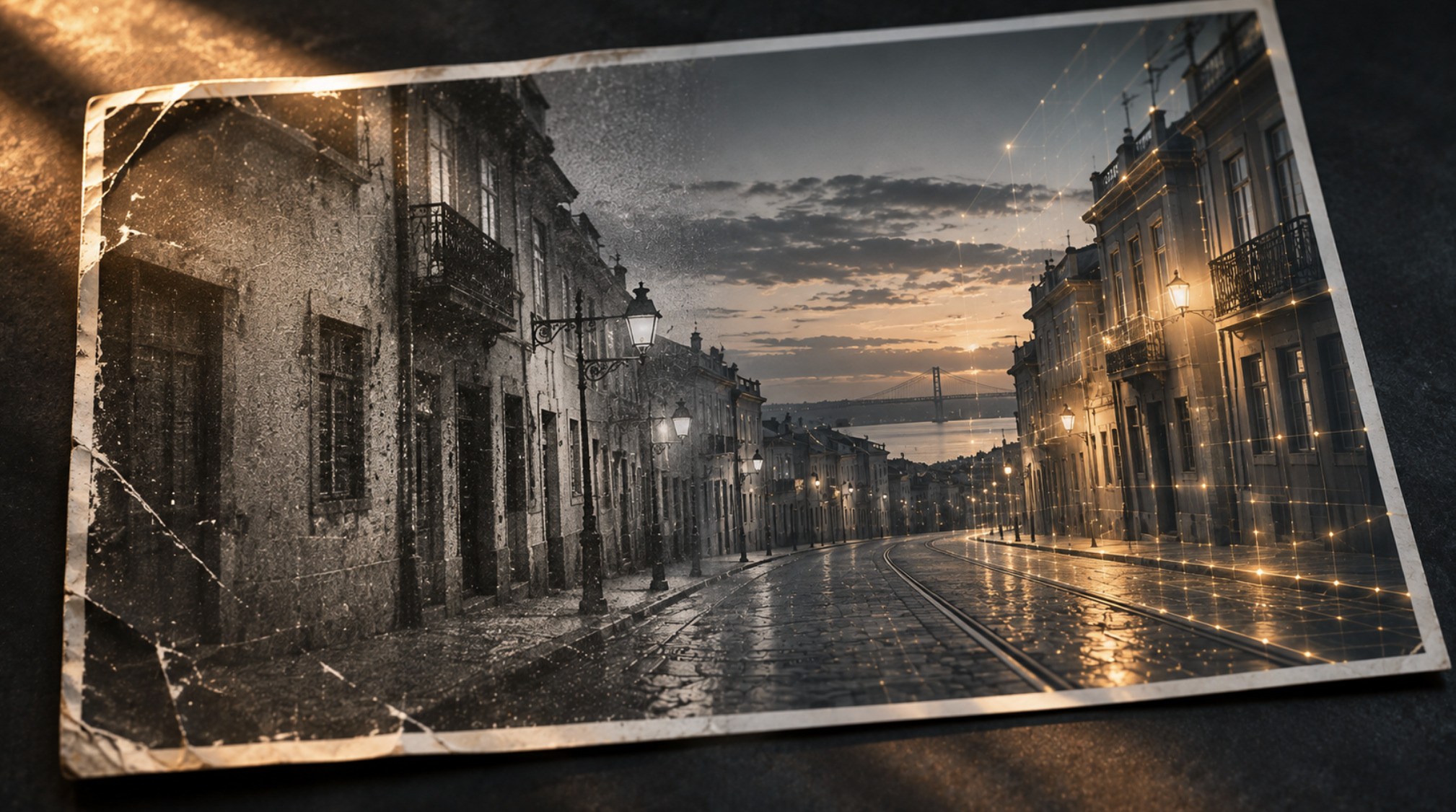
Twenty minutes later the picture is transformed. The shadows have opened up without noise. The wing mirror is gone, replaced by a convincing stretch of brick. The lamppost has dissolved. The software has rebuilt the hidden side of the man's face, matching his skin, his stubble and the fall of light across his cheek. The finished image is calmer, better balanced and more moving than the frame she shot. It looks, if anything, more like the moment felt.
And yet parts of it never existed. Nobody saw that stretch of brick. The face on the left side of the frame is a statistical estimate of what a face like his probably looked like, rendered so fluently that neither she nor any viewer could tell where observation ends and inference begins.
Photography has never been a neutral copy of the world. But that last edit raises a question older techniques rarely forced so sharply: at what point does editing stop interpreting a scene and start changing the event the photograph claims to show?
The myth of the innocent lens
Every photograph begins with a decision about what to leave out. The frame is the first and most powerful edit a photographer makes, and it happens before the shutter fires. A crowd can be made to look vast or sparse depending on where the edges fall. A protest can appear peaceful or violent depending on which ten metres of it the lens includes.
The interventions continue from there. Exposure decides whether a face emerges from shadow or a sky keeps its clouds. Lens choice reshapes space: a long telephoto compresses distance, stacking buildings or bodies so they appear closer than they were, while a wide-angle lens exaggerates the gap between foreground and background. Film stock carried its own character. Developers and papers changed contrast and tone.
In the darkroom, the hand of the printer was openly at work. Dodging held back light from parts of a print to keep them bright; burning gave other parts extra exposure to darken them. Ansel Adams treated the negative as a score and the print as a performance, and his printing of a single negative could change markedly over the years. Retouchers worked directly on negatives with pencils and dyes to soften skin or remove blemishes. Colour correction, in both chemical and digital eras, has always involved choices about what "accurate" colour even means under mixed light.
History also records manipulation of a different order. Roger Fenton's 1855 photographs of a cannonball-strewn road in Crimea exist in two versions, one with the balls on the road and one without, and historians have long debated whether he rearranged the scene. Soviet image editors removed purged officials from photographs, most famously the secret-police chief Nikolai Yezhov, who disappeared from a picture of himself walking beside Stalin. In 1982 a National Geographic cover moved the pyramids of Giza closer together so they would fit a vertical format.
These examples are useful precisely because they are different. Dodging a face to lift it from shadow changes how the viewer sees a man who was there. Erasing Yezhov changes who was there. The first is an interpretation of a recorded event; the second is an alteration of the record itself.
That distinction — between aesthetic interpretation and factual alteration — is the closest thing photography has to a stable ethic. It explains why photojournalists have long accepted tonal adjustments and cropping while treating the removal or addition of objects as a serious offence. Authenticity in photography has never meant mechanical fidelity. It has meant that the image's relationship to the scene is the relationship it claims to have.
Five ways software can touch an image
"AI editing" is now used for everything from a noise-reduction slider to an image conjured from a sentence. Lumping these together obscures the one question that matters for truth: does the operation transform information the camera recorded, or does it introduce information the camera never recorded? Five broad categories help separate the two.
Conventional pixel-based editing applies mathematical operations to existing pixel values. Curves, levels, white balance, saturation, cropping and traditional sharpening all belong here. Sharpening, for instance, increases contrast along edges that are already present; it cannot create an edge that the sensor did not register. These tools can still mislead — an aggressive crop or a darkened sky can change a picture's meaning — but they work with what was captured.
Computational photography combines several captures, or several readings of one capture, into a single image. Multi-frame noise reduction, exposure bracketing for HDR and focus stacking all fall into this category. The output is a synthesis, but a synthesis of real light from the real scene, usually taken within a fraction of a second. Its distortions tend to come from time: a moving hand blurred or doubled across frames.
Machine-learning-assisted enhancement uses trained models to make better guesses about recorded data. Modern denoising tools, for example, use neural networks to distinguish noise from fine texture more intelligently than older algorithms. Segmentation models identify sky, skin or a subject so that conventional adjustments can be applied selectively. Here the model is mostly deciding how to process existing information. But the boundary blurs at extremes: a denoiser pushed hard on a very noisy file may produce textures that look plausible rather than ones that were present.
Generative image reconstruction is where the camera's record is no longer the only source. Generative fill, AI object removal and background replacement ask a model to paint pixels that fit their surroundings. AI upscaling that promises to restore detail at high magnification does something similar: it predicts what fine structure probably looked like, based on patterns learned from millions of other images. Those predictions can be convincing and wrong. Reviewers testing generative zoom on recent smartphones have reported invented textures, distorted animals and mangled lettering — the classic artefacts of a model filling gaps with likelihood rather than evidence.
Fully synthetic generation produces an image without any camera input at all, from a text prompt or from other images. The result may be photographic in style, but it is not a photograph in any meaningful sense: no light from a scene ever reached a sensor.
The practical line runs through the middle of this list. The first two categories, and most uses of the third, transform recorded information. The last two introduce synthetic information. That does not make reconstruction inherently deceptive — removing a sensor-dust spot with a generative brush is as harmless as cloning it out by hand — but it does mean the resulting pixels carry a different kind of claim. They report what was likely, not what was seen.
The same edit, seven different verdicts
Whether an alteration matters depends less on the tool than on the promise an image makes. Photographs carry an implied contract with their viewers, and that contract varies sharply by genre.
Fine-art photography makes the loosest factual promise. Viewers of a gallery print generally understand that they are looking at an artist's vision. Composite landscapes, invented skies and wholly constructed scenes have a long and respected history. The ethical question here is mostly about honesty of presentation: an artist who builds a scene and then claims it as a lucky encounter has crossed a line, even if the image itself is legitimate.
Fashion and advertising operate under a widely understood expectation of polish. Audiences know that skin is retouched and products are perfected. But that expectation has limits, and they are increasingly codified. Several countries regulate how altered bodies can be shown in advertising, and advertising standards bodies routinely rule against images that exaggerate what a product actually does. Generative editing raises the stakes because it can alter a body or a product with far less effort and far more realism than the airbrush ever could.
Documentary photography occupies a middle ground that is easy to underestimate. A long-term project about a community may be personal and interpretive in style, yet it is valued precisely because its subjects and events are real. Removing a bystander from a documentary frame may seem cosmetic. It also changes who was present.
News photography makes the strongest claim of all: this happened, here, like this. That is why news organisations draw their lines so tightly. The Associated Press's standards say it does not alter any elements of its photographs and does not permit generative AI to add or subtract elements. World Press Photo's rules for its 2026 contest disqualify any entry that is synthetic or that used generative fill in post-production. The scrutiny cuts both ways: in March 2024, several major photo agencies withdrew a royal family portrait released by Kensington Palace after spotting signs of manipulation, and the Princess of Wales subsequently acknowledged editing it. The edits were not dramatic. The breach of the contract was.
Scientific imagery applies a stricter standard still. In microscopy, astronomy or medical imaging, an image is data. Many journals publish detailed rules on what adjustments are permitted — typically uniform changes to brightness and contrast applied to the whole image — and treat selective alteration as potential misconduct. An AI upscaler that invents plausible cellular detail would be indefensible in this context, however attractive the result.
Personal photography is the most ambiguous category, and the one where generative tools are spreading fastest. A family photo with a stranger removed from the background is, for most people, simply a nicer memory. But personal images do not always stay personal: they become evidence in insurance claims, in legal disputes, in news stories about the people in them. An edit that was harmless in a photo album can become significant later.
Across every genre, the same principle applies. The problem is not alteration as such; it is the gap between what an image implies and what was actually done to it. Disclosure closes that gap. A labelled photo-illustration, a caption noting that an image is a composite, or an advertising disclaimer can make an edit acceptable that would otherwise be deceptive. Audience expectation is the variable that decides how much disclosure is enough.

When the camera becomes an interpreter
For most people, the first edit now happens before they open any editing app. A smartphone "photograph" is rarely a single exposure. Press the shutter and the phone has typically already been buffering frames; it aligns several of them, merges them to suppress noise, blends darker and brighter versions to hold detail in sky and shadow, and applies tone mapping tuned by its manufacturer. Night modes extend this across longer bursts, sometimes several seconds, aligning frames despite hand movement. The image you see is a reconstruction from many moments, not a record of one.
Other interpretations follow. Portrait modes use segmentation — models that estimate which pixels belong to a person and which to the background — and then simulate the shallow focus of a wide-aperture lens. When segmentation misjudges a strand of hair or the edge of a glass, the blur gives the game away. Computational sharpening and scene optimisation adjust contrast, colour and texture depending on what the phone thinks it is looking at: food, foliage, sky, faces. Each manufacturer tunes these choices differently, and they change from one software update to the next, which is why the same scene photographed on two phones can look like two different afternoons.
None of this is fabrication in the ordinary sense. These pipelines mostly redistribute and refine real light. But some recent features move further along the spectrum described earlier. In 2023 a widely shared test suggested that one manufacturer's moon photographs were adding lunar detail that the sensor had not resolved; the company explained that its software used AI-based detail enhancement for the moon. In 2025 Google introduced a feature on its Pixel 10 Pro phones that applies a generative model to digital zoom at extreme magnifications, explicitly filling in detail the sensor could not capture. Google keeps the unprocessed version alongside the enhanced one and labels the result with Content Credentials indicating that AI tools were used — an acknowledgement, built into the product, that this is a different kind of image.
The significance for photographers is not that phones are lying. It is that "unedited" no longer describes a natural state. A file straight out of a phone may already embody dozens of algorithmic judgments about what the scene should look like. For most purposes that is fine. For documentary and evidentiary work, it means professionals need to know what their device does by default, which features can be switched off, and which modes introduce generated content rather than processed capture.
Can a photograph vouch for itself?
If viewers cannot see where observation ends and inference begins, one response is to make the file itself carry the answer.
The simplest version already exists in every digital camera. Capture metadata — EXIF data recording camera model, exposure settings, time and sometimes location — travels with most image files. But ordinary metadata is easy to edit, routinely stripped by social platforms, and proves nothing on its own.
The more ambitious approach is cryptographic. The C2PA standard, developed by the Coalition for Content Provenance and Authenticity, defines a way to attach a signed record — a manifest — to an image file. The manifest can describe how the image was captured, which tools edited it and what kinds of edits were made, including whether generative AI was involved. Each step is signed, so later tampering becomes detectable. Users encounter this under the name Content Credentials, the consumer-facing label promoted by the Content Authenticity Initiative.
Adoption has moved from promise to product. Leica's M11-P, released in 2023, was the first camera to sign images at capture. Sony, Nikon, Canon and others have since added signing to some professional bodies, often aimed at news agencies. Google's Pixel 10 phones sign photos in the camera app, and Samsung attaches credentials to images altered with its generative editing tools. Major editing software can record generative edits in the same format.
The limits are as important as the progress.
Provenance systems depend on keys and certificates, and those can fail. In 2025 Nikon suspended its credential service for one camera after a vulnerability was discovered, revoking the certificates it had issued. Credentials can be stripped by platforms that discard metadata, or bypassed entirely by taking a screenshot or re-photographing a screen. Most images in circulation carry no credentials at all, because most devices still do not create them and most platforms do not display them.
More fundamentally, provenance is not truth. A perfectly signed file proves that a particular device captured a particular set of pixels at a particular time, and that certain edits followed. It cannot prove that the scene in front of the lens was not staged, that the caption is accurate, or that the frame was not chosen to mislead. A signed photograph of a carefully arranged event is still a photograph of a carefully arranged event.
The reverse also holds. Missing provenance is not evidence of manipulation. An unsigned photograph may come from an older camera, a stripped upload or a careful photographer who simply never enabled the feature. Treating every image without credentials as suspect would discard much of the world's genuine photography.
The same caution applies to automated detection. Tools that try to classify images as AI-generated or authentic have improved, but they produce false positives and false negatives, they struggle with heavily compressed files, and they tend to lag behind each new generation of image models. A detector's verdict is a probability, not a ruling, and no responsible editor should treat it as the latter.
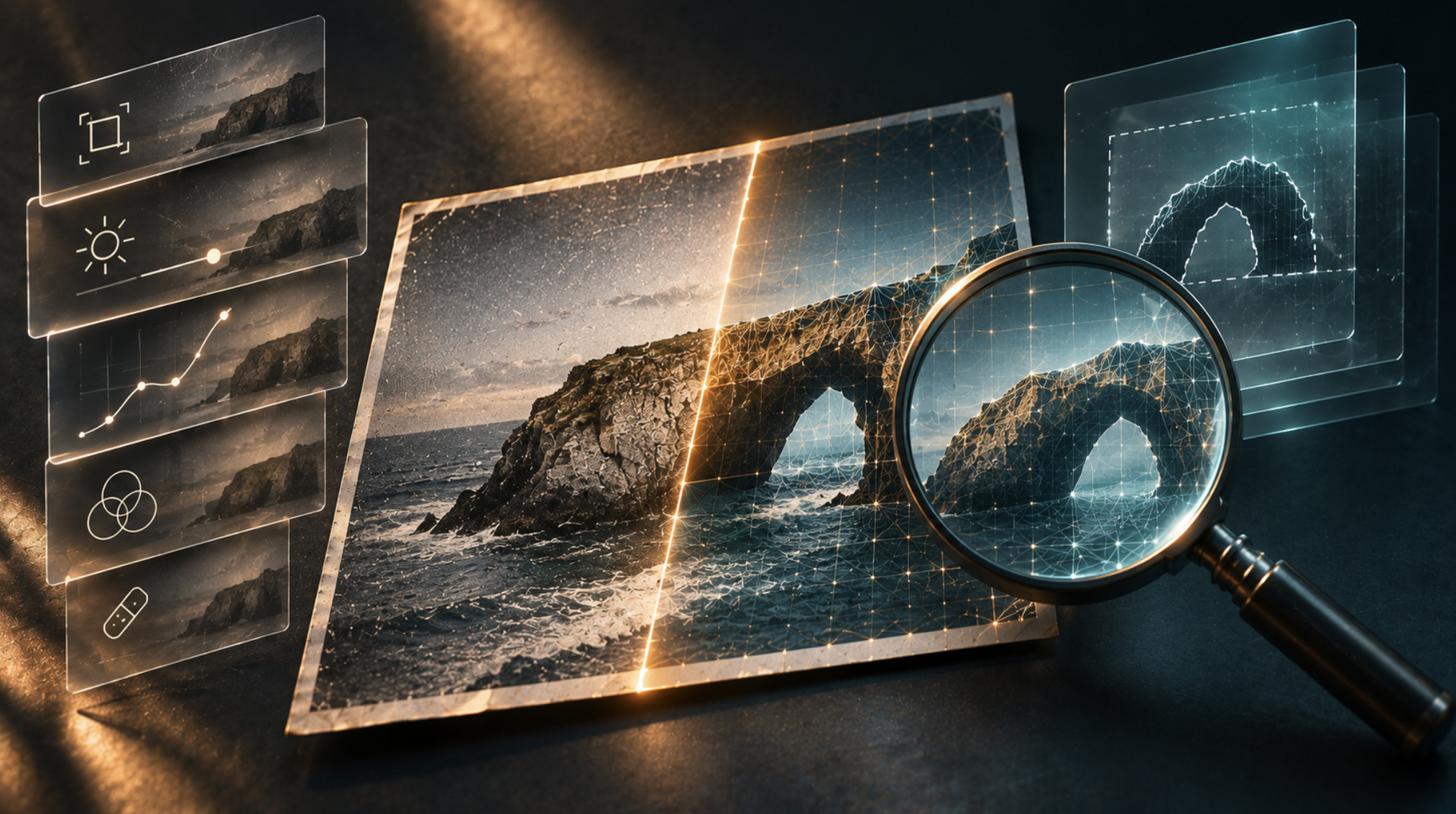
Four questions before the export button
No rulebook can anticipate every edit, but four questions, asked in order, resolve most real cases.
What was changed? Begin with the pixels, not the software. Did the edit alter how something looks — its brightness, colour, contrast, sharpness — or did it alter what is there? Removing a lamppost, adding a cloud, opening a closed eye or rebuilding a hidden face all change content. Brightening a face does not. The tool used is secondary; a clone stamp can fabricate and a generative model can merely tidy.
Why was it changed? Purpose separates correction from deception. Fixing sensor dust, lens distortion or a colour cast is corrective: it moves the image closer to what the eye saw. Aesthetic edits pursue mood or balance. Illustrative edits make a point that the photograph alone could not, and belong under an illustration label. Deceptive edits aim to make a viewer believe something about the scene that is not so. The same action — erasing a figure — can be aesthetic in an art print and deceptive in a news report.
What does the audience expect? This is the genre test from earlier. An image presented as art, advertising, documentation or evidence carries a different implicit promise, and context determines which promise a viewer hears. A picture moving from a portfolio into a news story changes its contract without a single pixel changing.
Should the alteration be disclosed? The practical test is materiality: would knowing about this edit change how a reasonable viewer understands the image? If yes, disclose it — in the caption, the credit line, the provenance record or all three. If disclosure would make the image unusable for its intended purpose, that is usually a sign the edit should not have been made.
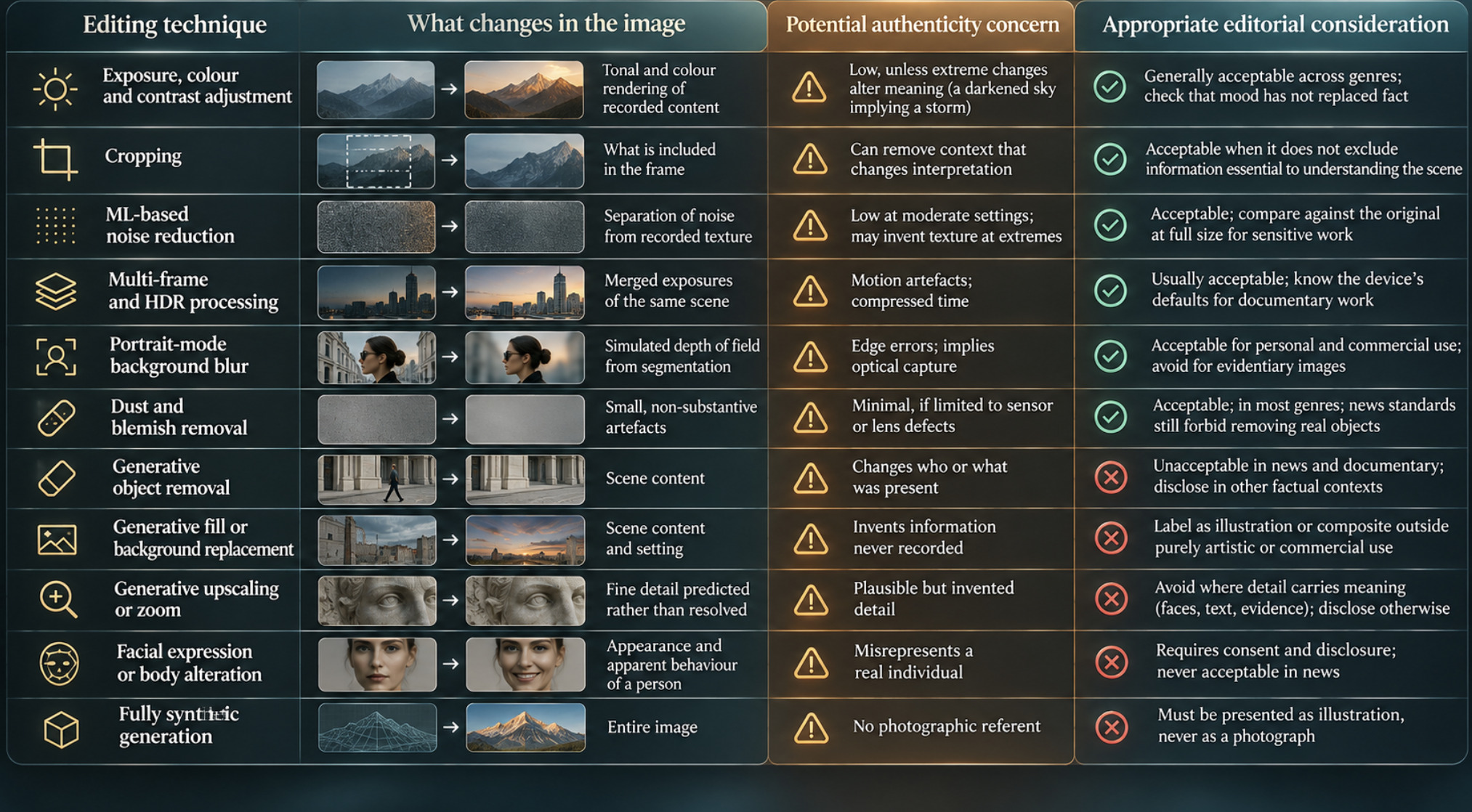
The table is a starting point, not a verdict. A blurred background in a family portrait is harmless; the same effect on a photograph used to identify a location could remove the very detail investigators need.
Trust is a practice, not a file format
Some of the adaptation is already visible. News agencies and contests have written explicit rules about generative tools, and those rules are converging on a common line: tonal and corrective work is acceptable, while adding or removing content is not. Several camera makers now offer signed capture to professional users, and some wire services have begun building signed workflows around them. These are established practices, not predictions.
Other developments are still uncertain. It is not yet clear whether provenance display will become routine on the platforms where most people actually see photographs, or whether audiences will learn to read a credential the way they read a byline. Regulators in several jurisdictions are moving towards labelling requirements for synthetic media, but how those rules will apply to edited photographs, rather than wholly generated images, remains unsettled.
What photographers and publishers can do now is less dramatic and more durable. Clear editorial policies that name specific tools and techniques, rather than relying on general principles, give staff and contributors something concrete to follow. Transparent workflows — keeping original files, recording significant edits, enabling credentials where the equipment allows — make it possible to answer questions later. Responsible use of generative tools means deciding in advance where they are appropriate, not discovering after publication that they were used. A commercial studio might embrace generative backgrounds freely; a documentary photographer might ban them entirely; both positions can be coherent if they are stated.
Underlying all of this is the oldest safeguard in photography: judgment. A provenance record can show that a file is intact. It cannot tell an editor whether the photographer was standing where the caption says, whether the scene was arranged, or whether the frame leaves out the half of the story that matters. Verification technology narrows the questions. It does not remove the need for someone to ask them, and to be accountable for the answer.
The difference between a beautiful image and a trustworthy photograph
Go back to the street at dusk. The edited frame is better than the one she shot: better balanced, more expressive, closer perhaps to what she felt standing there. As a picture, it succeeds.
Whether it succeeds as a photograph depends entirely on what she says it is. Hung as a print and titled as an interpretation, it is an honest work of art made with contemporary tools. Published in a local paper as a record of a man crossing a street, with a face the software imagined and a wall that was never there, it is something else. The pixels are identical. The claim is not.
That is why the question "was AI involved?" leads nowhere useful. AI was involved in the denoising, almost certainly in the phone's capture pipeline, and possibly in the camera's autofocus. What matters is whether the image represents what it claims to represent — whether its relationship to the scene is the relationship it asserts.
Photography has always been part record and part interpretation. Generative editing does not abolish that balance; it simply makes it possible to tip it without anyone noticing. A beautiful image asks to be admired. A trustworthy photograph asks to be believed, and belief is the one thing no tool can generate on the photographer's behalf.