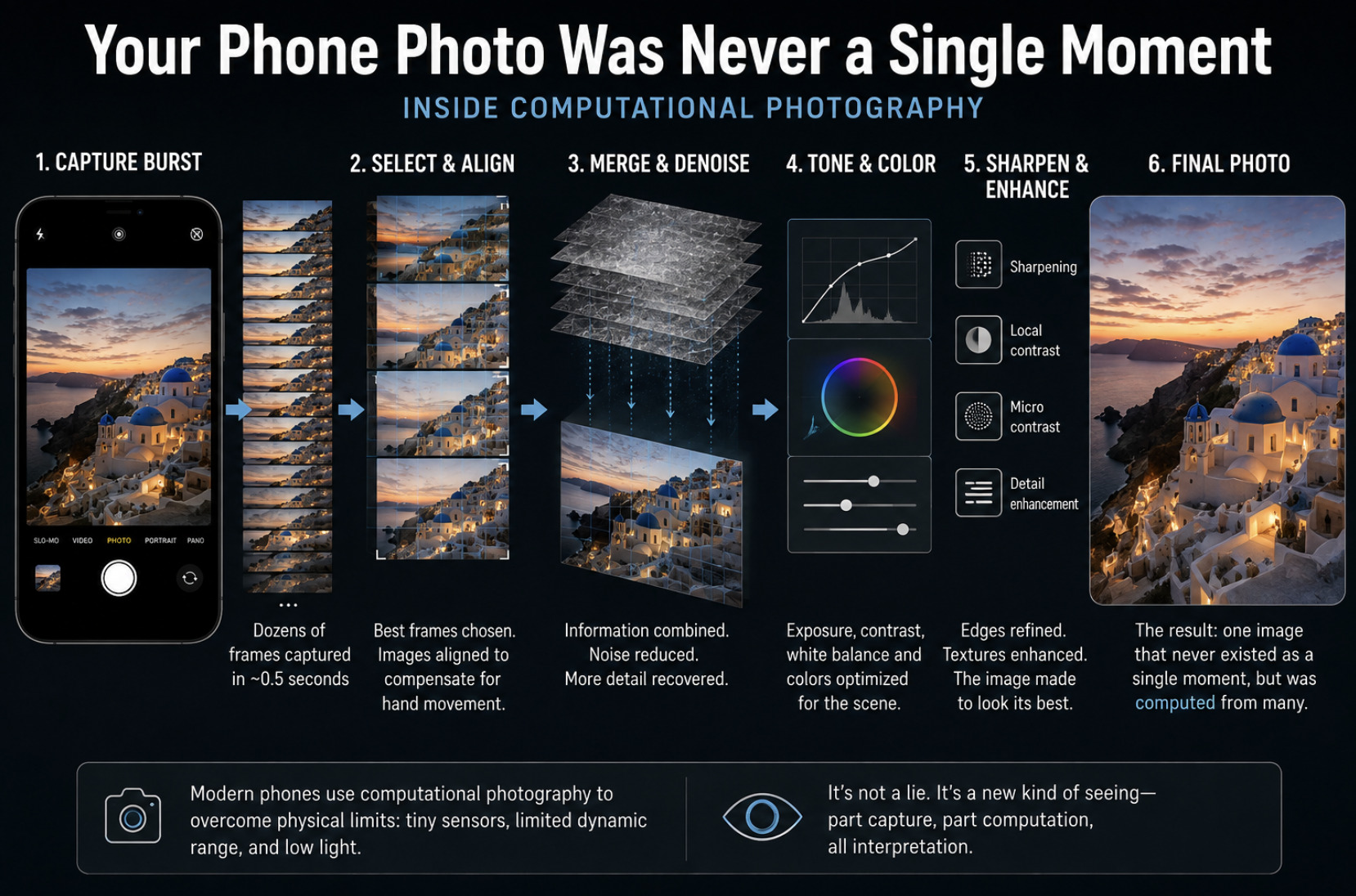
Press the shutter on a modern smartphone and you feel like you have captured an instant — one slice of light, frozen. You have not. In the fraction of a second around that press, the phone quietly recorded a burst of separate frames, analysed them, threw some away, aligned and merged the rest, reduced their noise, adjusted their tones, sharpened their edges, and assembled a final image that never existed as a single exposure at all. The photograph on your screen is not a record of one moment of light. It is a computation, reconstructed from many moments by software. This is computational photography, and it is the reason a tiny phone sensor can produce images that would once have required a large camera and careful conditions. Understanding how it works changes not just how you take pictures, but what you think a photograph fundamentally is.
The problem a phone camera has to solve
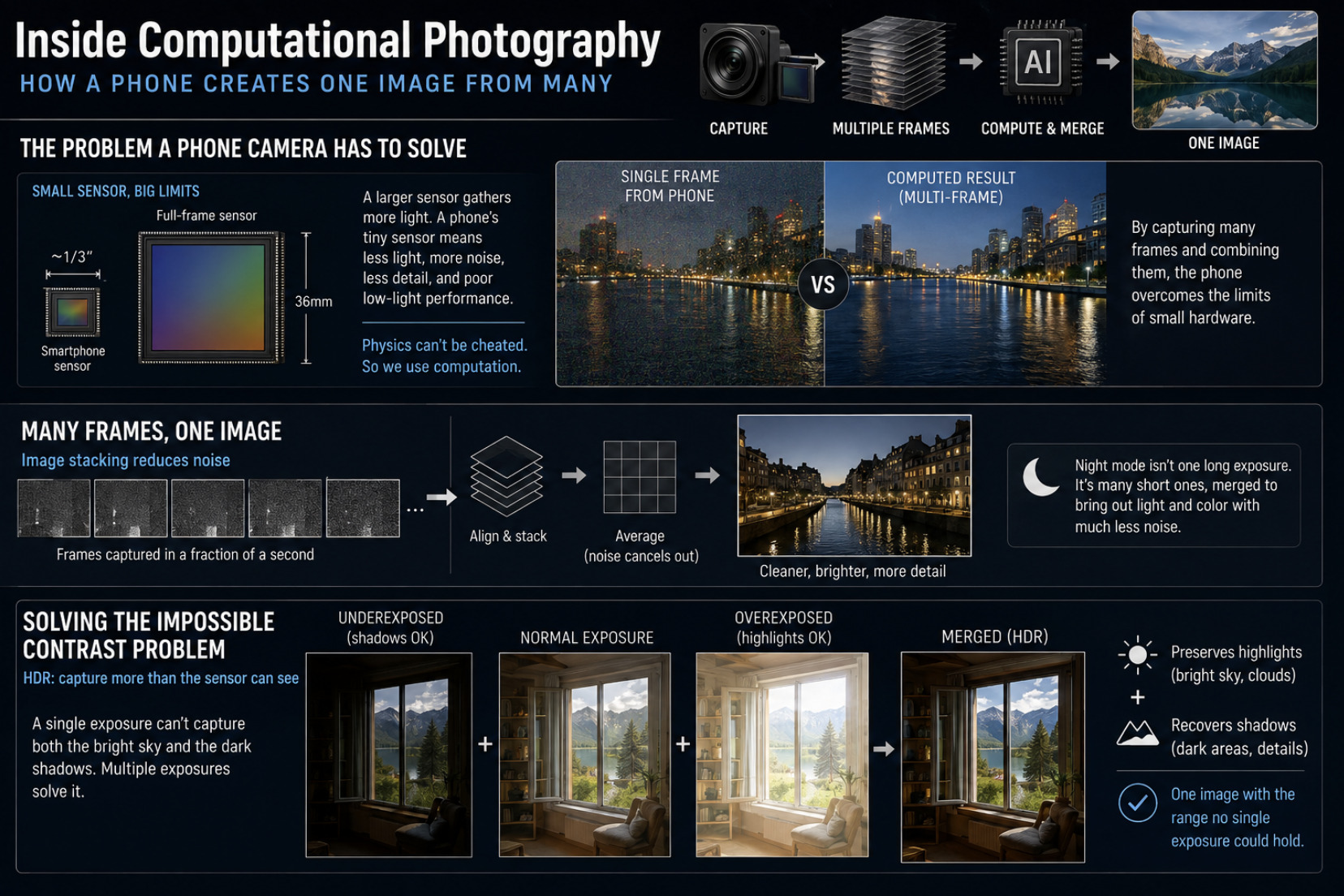
To appreciate why computational photography exists, start with a physical fact that no amount of marketing can escape: a smartphone camera is very small. The sensor that gathers light is a fraction of the size of one in a dedicated camera, and the lens is correspondingly tiny. In photography, size is not a vanity — a larger sensor gathers more light, and more light means less noise, more detail, and greater ability to cope with difficult conditions like dimness or high contrast. By the hard rules of optics, a phone's tiny sensor should produce mediocre images, especially in low light or scenes with both bright sky and dark shadow.
For years, that is exactly what phone cameras did. The images were fine in bright, even light and fell apart the moment conditions got hard. The physics could not be cheated: a small sensor simply cannot collect the light a large one can. So the industry stopped trying to win on optics alone and changed the game entirely. If a single exposure from a small sensor is not good enough, the reasoning went, then do not rely on a single exposure. Capture many, and use computation to extract from that collection an image far better than any one of them could be. Computational photography is, at its heart, a way of using software and processing power to overcome the physical limits of small hardware — and it has succeeded so completely that most people never realise the trick is happening at all.
Many frames, one image
The foundational technique is deceptively simple to state and remarkable in effect: instead of taking one picture, the camera takes several in rapid succession and combines them. This is often called image stacking or multi-frame capture, and it addresses the small sensor's biggest weakness — noise. Noise, the random grain that plagues images from small sensors, is by its nature random, differing from frame to frame. When the camera aligns multiple frames of the same scene and averages them together, the consistent real detail reinforces while the random noise, differing each time, tends to cancel out. The result is an image far cleaner than any single frame, effectively synthesising the light-gathering of a bigger sensor from many small captures.
This multi-frame foundation is what makes the phone's most impressive feats possible. A night mode photograph — the kind that turns a near-dark scene into a clear, usable image — is not a single long exposure but many frames captured and intelligently merged, extracting a bright, low-noise result from conditions where a single shot would show mostly grain. The phone is, in a real sense, gathering light across time and stitching it together, using computation to accumulate what the small sensor cannot gather at once. When you marvel that your phone took a clean photo in a dim restaurant, you are marvelling at software assembling an image from a burst you never saw.
Solving the impossible contrast problem
Multi-frame capture also cracks one of photography's oldest and hardest problems: dynamic range, the gap between the brightest and darkest parts of a scene. The human eye handles a bright sky and a shadowed foreground effortlessly, but a camera sensor cannot — expose for the bright sky and the shadows go black; expose for the shadows and the sky blows out to white. A small sensor is especially limited here, and traditional photography forced a choice between the two.
Computational photography refuses the choice. By capturing multiple frames at different exposures — some to preserve the highlights, some to lift the shadows — and merging them, the phone can build a single image in which both the bright and dark regions retain detail, a range no single exposure from that sensor could hold. This is the science behind the modern "HDR" photo, and it is why your phone can photograph a person standing against a bright window without turning them into a silhouette. The final image is a composite, tone-mapped from several exposures into something that looks natural to the eye while representing a range of light the sensor could never capture in one shot. It is, quite literally, a picture of more light than the camera can physically see at once.
When the camera starts to understand the scene
The most profound shift in computational photography is the newest: cameras have begun not just to merge frames but to understand what they are looking at. Using techniques from artificial intelligence, modern phones analyse the content of a scene — recognising that this region is a face, that one is sky, this is foliage, that is text — and process different parts of the image differently based on what they are. Skin can be treated one way, sky another, greenery another, all within the same photograph. The camera is no longer applying a single global adjustment; it is making semantic decisions about the meaning of what it sees.
This is where computational photography shades into something that challenges the old idea of a photograph as a neutral recording. The portrait mode that blurs a background to imitate a large lens is not optics but computation — the phone identifies the subject, estimates depth, separates foreground from background, and synthesises the blur artificially. When the camera recognises a face and subtly brightens and smooths it, or identifies the sky and deepens its blue, it is making interpretive choices about how the scene should look, not merely how it did look. The image is being actively constructed according to the camera's model of what a good photograph of this kind of scene ought to be. Increasingly, the phone is not documenting reality so much as producing an idealised, computed version of it, and the line between capturing and creating grows thin.
What this means for the photograph
All of this raises a genuine and slightly unsettling question that photographers of every level now have to reckon with: if the image is captured across multiple frames, denoised, tone-mapped from several exposures, and selectively adjusted according to the camera's understanding of the scene, in what sense is it still a straightforward record of a single moment of reality? The traditional idea of a photograph — light passing through a lens onto a surface in one instant — no longer describes what a phone actually produces. What it produces is a reconstruction, an image computed from many inputs and shaped by software's judgement about how the scene should appear.
This is not a reason for dismay, but it is a reason for awareness. The photographs are often better — cleaner, more balanced, more usable — than anything the small sensor could produce honestly, and that benefit is real. But they are also further from a neutral document than they appear, and understanding that helps you use the tool with clear eyes. Knowing that your phone is making interpretive choices lets you decide when to let it and when to override it, and it reframes the editing you do afterwards — the deliberate, considered adjustments explored in the fine line between editing a photo and overcooking it — as one more layer on top of a process that began computing the image the instant you pressed the shutter. The camera has already made choices; your edits continue a conversation the software started.
The photograph, redefined
Computational photography represents one of the most significant shifts in the medium since the arrival of digital sensors, and its most important consequence is conceptual rather than technical. The photograph has quietly changed from a captured moment into a computed reconstruction — an image assembled by software from many frames and many decisions, designed to look like a single beautiful instant while being nothing of the sort underneath. That your phone can rival cameras many times its size is not because the physics changed. It is because the definition of taking a picture did.
For anyone who cares about images, the practical wisdom is to hold two things at once. The technology is genuinely marvellous, and the pictures it produces are genuinely good, often better than the hardware has any right to deliver. At the same time, they are constructions, shaped by choices you did not make and cannot always see, and the composition and intention you bring — the deliberate framing and seeing that no algorithm supplies, as we discussed in the composition choices that quietly make a photo work — matter more than ever precisely because the capture itself has become automated. The camera will compute you a technically excellent image. What it still cannot compute is what to point it at, and why. That remains, as it always was, the photographer's alone.